Grack AI evidence system
Every health claim needs a visible trail.
This case study defines the complete product contract: which sources are eligible, how the prompt binds claims to evidence, what gets verified before display, and when Grack should return uncertainty.
How evidence reaches the answer.
Prompting is one control inside a larger system. Retrieval supplies inspectable evidence; verification checks that the answer stayed inside it.
Every supported claim carries its source. If the evidence is missing or insufficient, Grack removes the unsupported conclusion and makes the uncertainty visible.
- 01
Curate
Admit guidelines, consensus statements, and peer-reviewed studies with clear provenance and dates.
- 02
Retrieve
Pass the smallest relevant evidence passages with stable source IDs—not an untraceable document dump.
- 03
Constrain
Bind clinical and quantitative claims to supplied evidence inside the developer prompt.
- 04
Verify
Block unsupported claims, broken citations, dose guidance, and answers that hide uncertainty.
Inspect the three controls that turn “use evidence” into an implementable product requirement.
DEVELOPER INSTRUCTION · EXCERPT
Prompt contract
- 01Separate the user's observed data from published evidence.
- 02Use only supplied evidence IDs for clinical or quantitative claims.
- 03Place [source_id] directly after the supported claim.
- 04If evidence is absent or conflicting, state the uncertainty or decline the claim.
- 05Never diagnose, prescribe, or recommend a dose change.
The prompt defines the behavior contract. It does not create evidence by itself.
Visible answer controls
Personal calculations, claim-level support labels, openable source links, medication-safety boundaries, and an explicit no-evidence fallback.
Evidence quality system
Curated retrieval, claim–citation alignment, source-version records, failure monitoring, and clinician-reviewed quality sampling keep the evidence path inspectable.
Inside the Grack app
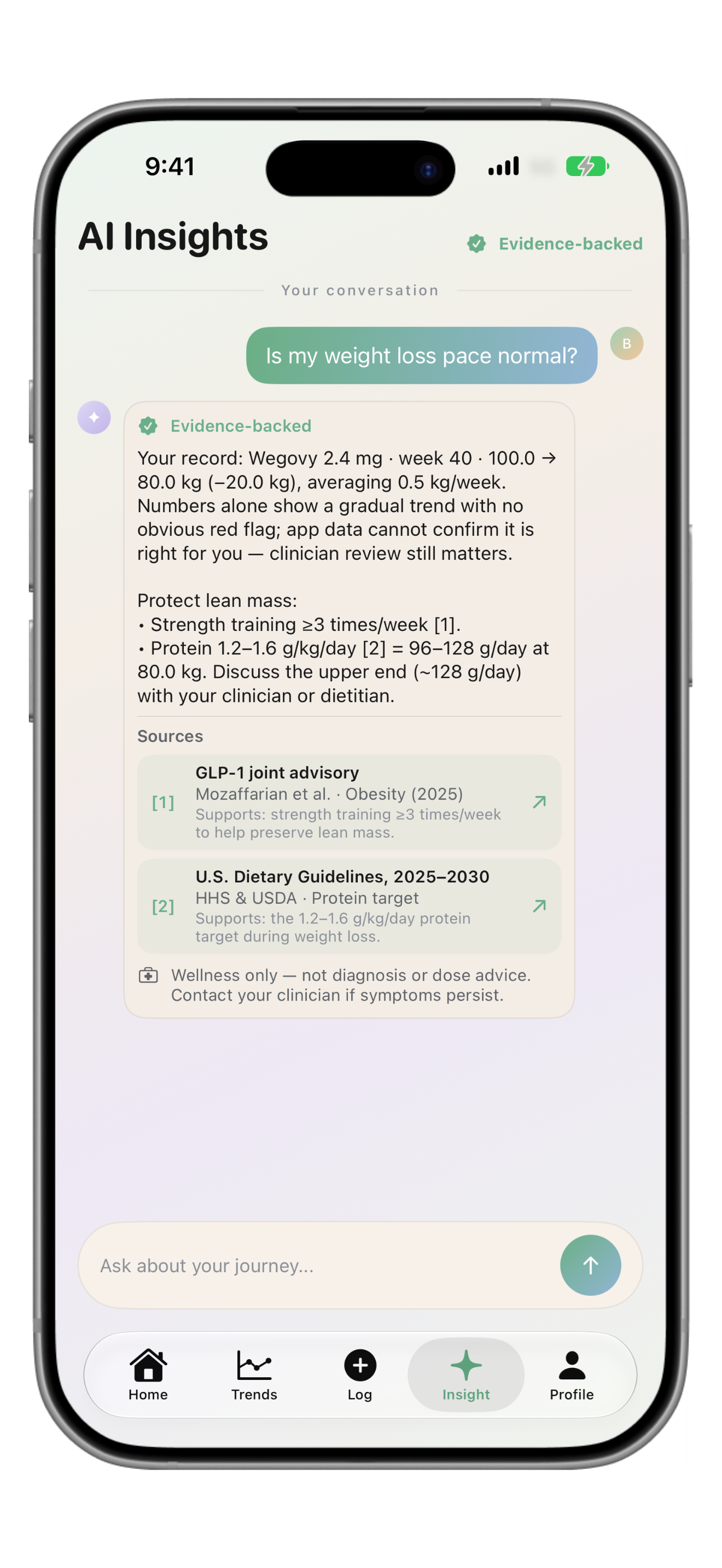
One answer. Four checks.
The interface keeps personal observations, sourced recommendations, citation metadata, and the clinical boundary visually separate.
- Observed record
- Wegovy 2.4 mg · week 40 · 100.0 → 80.0 kg · calculated as 0.5 kg/week
- Evidence-linked claim
- Strength training and the 1.2–1.6 g/kg/day protein range carry markers at the claims they support.
- Source object
- Each marker opens a named source and explains which nearby claim that source supports.
- Clinical boundary
- The answer describes the recorded trend and returns individual judgment and medication decisions to a clinician.
Evidence fallback
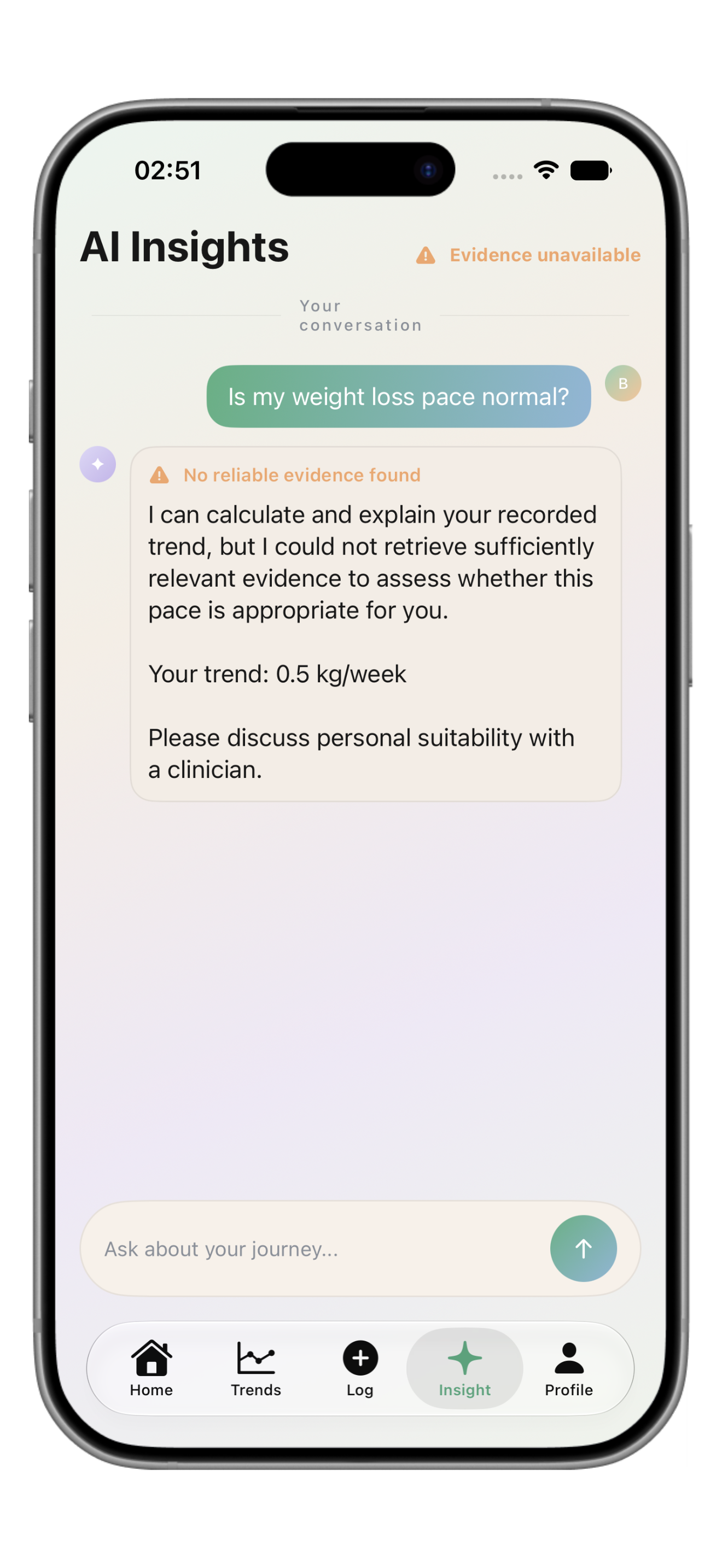
No evidence. No medical conclusion.
Grack can still reproduce the arithmetic from a user’s record. When sufficiently relevant evidence is unavailable, it removes the unsupported assessment, shows no citations, and returns personal suitability to a clinician.
- Keep the reproducible trend: 0.5 kg/week
- Remove the unsupported appropriateness judgment
- Show no source card without a reliable supporting source
- Ask a clinician to assess personal suitability
The rule is consistent: preserve what can be calculated, remove what cannot be supported, and make the boundary visible.
Context changes relevance.
Personal data selects the relevant arithmetic and wording. It never becomes clinical evidence, and it never relaxes the citation rules.
Use the comparison below to inspect both request states.
Interactive comparison
Choose what the model receives.
Select both states. Every field that changes is highlighted in the request path below.
Now showing: question only
On your iPhone
Your question
“Is my recent pace typical?”
No medication, weight, age, or HealthKit context is attached.
Grack backend
Minimize and constrain
- Empty values are omitted.
- The display name is not forwarded to the model.
- Server safety instructions are added.
Model request
Question only
The model receives the smallest useful payload plus rules against diagnosis, prescriptions, and dose changes.
Model credentials stay server-side.
Context changes relevance and arithmetic. It never lowers the evidence standard: clinical claims still require eligible sources and the same verification gates.
Boundaries remain explicit.
- No diagnosis or interpretation of symptoms as a condition
- No prescription or instructions to start or stop medication
- No dose, timing, or titration changes
- Severe symptoms and medication decisions return to a clinician
Evidence quality is measurable.
- Curated, versioned evidence library with an owner and review date
- Claim–citation checks before an answer reaches the UI
- Audit logs for sources, prompt version, refusals, and failed checks
- Clinician-reviewed quality sampling and a rollback threshold
The honest reliability claim.
Grack can constrain, inspect, measure, and improve AI output. No general-purpose model can guarantee zero hallucinations.
The release target is evidence-constrained behavior with visible failure handling: unsupported claims are removed, uncertainty is shown, and high-risk decisions return to a clinician.
Evidence and privacy need the same discipline.
Read the exact storage, AI, export, and deletion language shown inside Grack.